
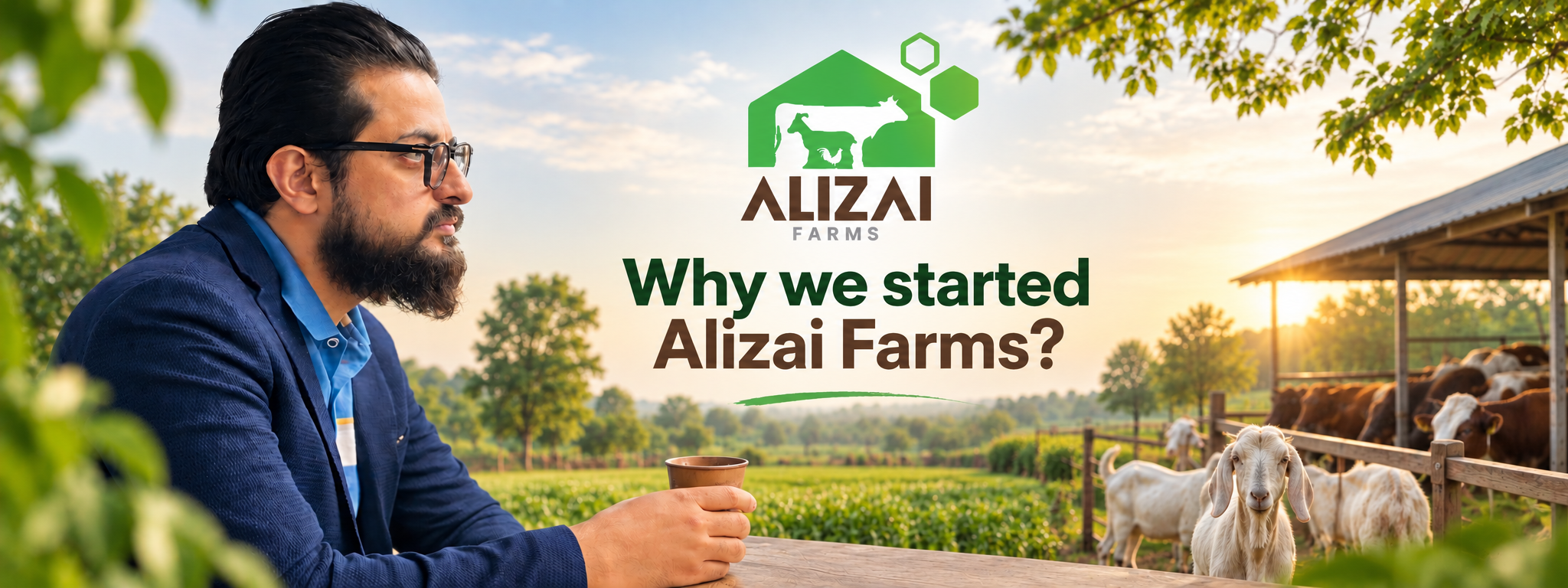
For most of my career, my world was software.
I built products, managed engineering teams, worked with international clients, and eventually became the Country Manager of a multinational technology company in Pakistan.
From the outside, farming looked like the opposite of everything I had spent my career building.
Software was global.
Farming was local.
Software moved at the speed of the internet.
Farming moved at the speed of seasons.
My work lived in the cloud.
Farming started with soil, water, animals, and my own hands.
But living and working in Pakistan taught me something important:
A good career does not always mean security.
In technology, your income can depend on a client thousands of kilometres away, another country's economy, exchange rates, company decisions, global competition, and now increasingly, artificial intelligence.
You can spend years building skills, teams and companies, and still realise that much of what you have built exists on somebody else's platform.
I wanted to build something different.
Something physical.
Something I could see growing in front of me.
Something connected to land, food and livestock, things people will continue to need regardless of what happens to the next generation of software.
So I started small.
Not with hundreds of acres.
Not with a huge dairy farm.
Not with a massive investment.
Just a small farm.
And suddenly I became a beginner again.
After years of discussing architecture, cloud infrastructure, software releases and business strategy, I was learning about soil EC, maize varieties, silage, cattle nutrition, irrigation, weight gain and animal health.
There was something humbling about it.
A software bug can sometimes be fixed in an hour.
A mistake in farming may take an entire season to understand.
You cannot deploy a patch to a crop.
You cannot ask an animal to grow faster because the deadline is approaching.
Farming forces you to respect biology, patience and consistency.
The engineer in me never disappeared.
And surprisingly, I started seeing similarities between the two worlds.
A farm is also a system.
There are inputs. There are outputs. There are bottlenecks. There is data.
There are processes that can be optimized. There are experiments that work, and experiments that fail.
I simply started applying engineering thinking to agriculture.
- Measure the animals.
- Track weight gain.
- Measure feed conversion.
- Study the soil.
- Improve the process.
- Automate where possible.
- Use data instead of assumptions.
Today, I don't see farming as leaving technology behind.
I see it as building the next chapter.
A business where technology supports something physical and real.
Where software, AI and automation can improve agriculture instead of replacing the business itself.
I went from being a software engineer, to leading teams, to becoming the Country Manager of a multinational company, and then back to the soil.
Not because my career failed.
But because I wanted to build something that could survive beyond my career.
Alizai Farms started small.
The ambition is much bigger:
To build a modern livestock and farming business in Pakistan where technology, data and traditional agriculture come together.
This is the journey from code to cattle, cloud to crops, and software to soil.
And we are just getting started.